Showing posts sorted by relevance for query tsetse. Sort by date Show all posts
Showing posts sorted by relevance for query tsetse. Sort by date Show all posts
Friday, October 17, 2008
History of tsetse fly control in the Okavango Delta
Recently received in HOORC's Library, University of Botswana historian Dr Maitseo Bolaane's Tsetse and trypanosomosis control in the Okavango Delta, c. 1930s - 1970s looks at the relationship among tsetse fly control, the cattle industry and game policy in northern Botswana over five decades. The "bumpy road of trial and error" to control the pest described in the paper included destruction of game, selective bush clearing, and spraying of insecticides. The paper notes that, while there seems to have been little attempt to incorporate indigenous knowledge about tsetse fly on the part of colonial administrators, in Botswana Africans made sustained efforts to observe the fly environment and to experiment with its control. The paper was published in the South African Historical Journal in 2007: you can find it in HOORC's Library.


Saturday, October 06, 2007
Tsetse task force for southern Africa
The African Union's Pan African Tsetse and Trypanosomiasis Eradication Campaign (PATTEC) has set up a technical task force to plan for a multi-national project to eradicate trypanosomiasis in the common tsetse belt in Malawi, Mozambique, Zambia and Zimbabwe. HOORC researcher and tsetse fly spraying monitoring specialist, Dr Casper Bonyongo will join William Shereni and David Zinyengere of Zimbabwe, and Dr Patrick Kgori of Botswana, as a member of the task force, which will begin its work the middle of this month with consultations in the relevant countries.
Friday, May 19, 2006
Tsetse fly control monitoring project
A team from HOORC begins environmental monitoring of tsetse fly control next week. This year, with the pest eliminated from the Okavango Delta, the Botswana Ministry of Animal Health and Production will be spraying over a three month period in the Kwando/Linyanti area of northern Botswana and the Caprivi Strip in neighbouring Namibia. The HOORC researchers will be looking at the impacts of the spraying on people living in the affected area, and on terrestrial and aquatic invertebrates and fishes.
The Pan African Tsetse and Trypanosomosis Eradication Campaign (PATTEC) was launched at the 26th meeting of the International Scientific Council for Trypanosomiasis Research and Control (ICSTRC) in 2001. The Campaign is coordinated by the African Union and its InterAfrican Bureau for Animal Research and supported by the Food and Agriculture Programme of the United Nations and the World Health Organization.
You can find out about the history of tsetse control in the Okavango Delta through a collection of studies and reports in HOORC’s Library.
The Pan African Tsetse and Trypanosomosis Eradication Campaign (PATTEC) was launched at the 26th meeting of the International Scientific Council for Trypanosomiasis Research and Control (ICSTRC) in 2001. The Campaign is coordinated by the African Union and its InterAfrican Bureau for Animal Research and supported by the Food and Agriculture Programme of the United Nations and the World Health Organization.
You can find out about the history of tsetse control in the Okavango Delta through a collection of studies and reports in HOORC’s Library.
Saturday, December 08, 2007
Tsetse spraying environmental monitoring report
 Open Billed Stork, courtesy of Hannelore Bendsen
The latest report in HOORC's work on tsetse fly control, Environmental monitoring of May-August 2006 aerial spraying of deltamethrin for tsetse fly eradication in the Kwando-Linyanti and Caprivi region, prepared by HOORC researchers Casper Bonyongo and Dominic Mazvimavi for Botswana's Department of Animal Health and Production has been completed. The report describes findings of monitoring during the work's first two phases -- pre-spraying and spraying. Findings for the recovery monitoring phase will follow. The study found relatively high impact on invertebrates and low impact on birds, fish and people. You can find the report, and its executive summary, in HOORC's Library.
Monday, February 25, 2008
Tsetse spraying recovery monitoring report
 Sampling aquatic invertebrates
The Botswana Department of Animal Health and Production has released Recovery monitoring after 2006 aerial spraying of deltamethrin for tsetse fly eradication in the Kwando-Linyanti and Caprivi region, edited by HOORC researchers Casper Bonyongo and Dominic Mazvimavi. The conclusion drawn from the 2006 spraying indicated that, in addition to affecting the intended targeted tsetse-flies, blanket deltamethrin spraying reduced the abundance of non-target terrestrial invertebrate taxa. The report recommends that the recovery monitoring programme continue until 2009, that non-target terrestrial invertebrate species be properly identified, and that studies aimed at conserving the most vulnerable species be carried out. You can find both this report and the report of the pre-spraying and spraying phases in HOORC's Library.
Thursday, April 05, 2007
Tsetse control environmental monitoring meeting
HOORC researchers presented the draft report of the 2006 environmental monitoring of aerial spraying of deltamethrin for tsetse fly control in the Kwando Linyanti region at a meeting at Maun Lodge on March 29th. The report was accepted and will be available in HOORC's library at the end of April 2007. Recovery monitoring work will begin in May. For further information contact Dr Casper Bonyongo or Dr Dominic Mazvimavi.
Friday, October 17, 2008
Tsetse fly spraying in the Okavango
 Spraying for tsetse fly control in the Okavango Delta, 1970s
From the Peter Smith Collection, University of Botswana HOORC Library Archives, Ref. SMITH/4/1/14
Monday, September 25, 2006
Tsetse control monitoring report
HOORC's library received the Final report : pre-spraying monitoring of sequential aerial spraying of Deltamethrin for tsetse fly eradication in the Kwando-Linyanti region by H. Bendsen, G. Mmopelwa and M. Motsholapheko today. The report, produced by HOORC for the Botswana Department of Animal Health and Production, recorded baseline data for conditions prior to the teste spraying operation that was carried out in May and June 2006, and makes recommendations for future mitigation and monitoring measures. You can find the report in HOORC's library.
Monday, July 31, 2006
Monitoring birds during tsetse eradication
The June issue of Birdlife Botswana’s Bird Conservation Newsletter has an article about the organization’s involvement in monitoring of the effects of aerial spraying of the synthetic pyrethroid, Deltamethrin, against tsetse fly on the bird populations in the Kwando/Linyanti area in northern Botswana and northeastern Namibia. Birdlife is focusing on four types of birds whose habitat and feeding behaviour suggest they might be vulnerable to the spray: the Slaty Eget, the Lappet Faced Vulture, the Little Bee Eater, and Arnot’s Chat. The full story can be found online on Birdlife Botswana’s web site. HOORC is coordinating overall monitoring of the effects of the 2006 spraying programme.
Thursday, January 26, 2006
HOORC Okavango Report Series No. Four
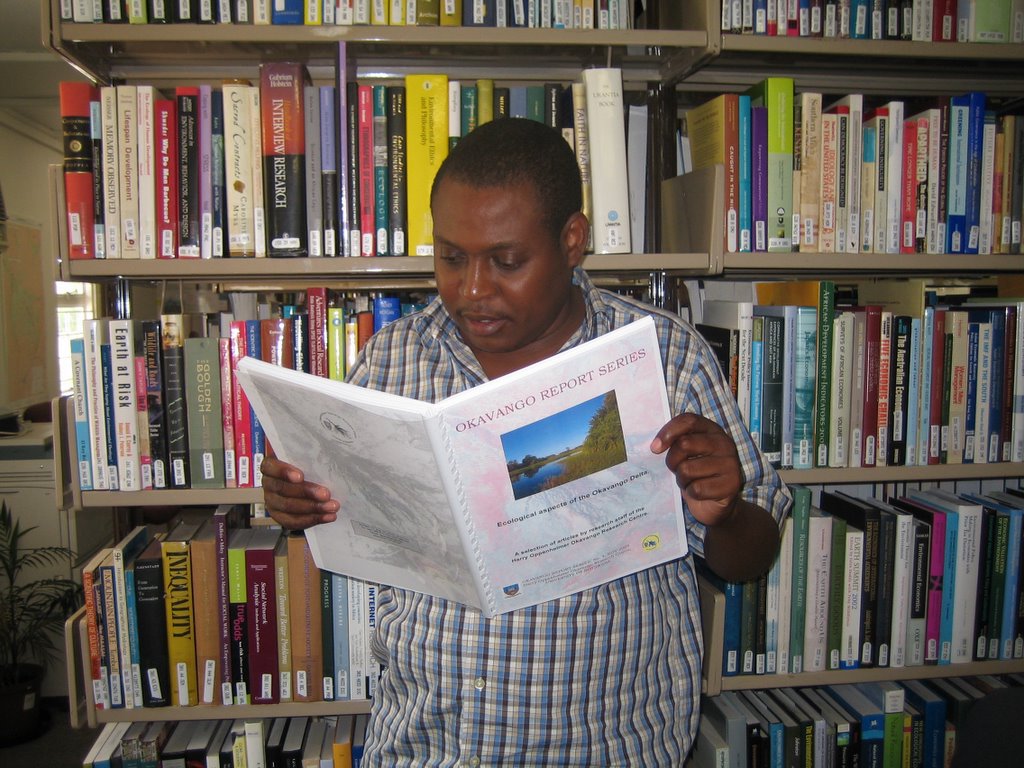
Herbert Kiberu, HOORC Library Officer, peruses Okavango Report Series Number Four, Ecological aspects of the Okavango Delta, issued by HOORC this week. The report, a compilation of papers by staff of the Centre, offers insight into some of the more important ecological issues of the inland Okavango wetland. Previous reports in the series are:
1. Environmental monitoring of tropical and subtropical wetlands : proceedings of a conference
2. Environmental monitoring of tsetse fly spraying impacts in the Okavango Delta, 2002-2003 : final report
3. Environmental recovery monitoring of tsetse fly spraying impacts in the Okavango Delta, 2003 : final report
You can find all these reports in the HOORC Library.
Thursday, May 27, 2021
Okavango Research Instritute (ORI) Library Collections
ORI library has the following special/personal collections:
- Peter Alexander Smith collection
- Dr Hans Joachim Heinz collection
- Dr Richard Bell collection
- The Hunting Records Collection
Peter Alexander Smith collection
Peter Alexander Smith collection - According to Morrison (2006) Peter Alexander Smith worked in various capacities during Bechuanaland and subsequently Botswana Government. His interest was in the areas of tsetse fly and invasive aquatic plant control. It was during his different working capacities that he collected a lot of rare and valuable information on various topics such as ecology, botany, hydrology and anthropology among others. After his death in 1999 most of his collection was donated to ORI. His collection also includes photographs, maps, correspondences, newspaper cuttings, herbarium specimens etc
Dr Hans Joachim Heinz collection
Dr Hans Joachim Heinz was a parasitologist who worked in the Okavango Delta for more than thirty years. His works documented the culture and indigenous knowledge of the bushmen in the Okavango Delta. His collection that have been donated to ORI includes books, films, slides and papers.
By Mosepele Mabutho
Saturday, June 09, 2007
Deltamethrin and dragonflies research project


Elmar Schuran, visiting student of odonatologist Jens Kipping, has installed test ponds for dragonfly larvae not far from HOORC’s library verandah. When filled with water, the ponds will allow scientists to observe the impact of the insecticide Deltamethrin on the development of dragonfly larvae. Deltamethrin is being sprayed in the Okavango region by the Botswana Department of Animal Health and Production to control tsetse fly. HOORC, contracted to monitor the environmental impacts of the spraying, expects that this controlled experiment will provide its researchers with a clearer picture of the long term physiological effects of the insecticide on other Delta invertebrates.
Monday, January 01, 2007
2006 in review
A variety of online end of the year reviews cover issues of interest to the
Thursday, July 27, 2006
HOORC Winter Course research presented
HOORC’s University of Botswana Winter Course wrapped up today with presentations by 15 undergraduate students who have spent the past eight weeks carrying out research about issues in the Okavango Delta region.
Tourism was a popular topic, with Vincent Mabikwa looking at the contribution of tourism to the growth of small-scale hospitality business in Maun, Pauline Setlhabi studying tourists’ willingness to pay for the conservation of lions in Moremi Game Reserve, Masa Selerio examining factors influencing tourism demand in Moremi, Rose Gabanthate studying the psychological benefits for tourists visiting a protected area, Jayson Chabota reviewing the role of print media in promoting awareness of tourism in the Delta, and Mahoko Tamajobe studying the impact of Internet marketing strategies on the Delta as a tourist destination.
Social and economic issues were addressed by Thomas Uaundjo-Mbura who looked at the role of churches in providing social welfare services in Maun, Boitumelo Vavani who studied factors affecting the learning environment of Junior Secondary School students in a rural and remote setting, Seeletso Moepeng who evaluated basket making in Etsha as a livelihood strategy and its role on poverty alleviation, Tuelo Bapedi who studied opportunities and challenges for benefits in CBNRM projects, Tefo Motlamme who reviewed the evolution of land use and livelihoods activities in the Lake Ngami Area from the 1940s until the present, and Monosi Mopako who took part in a preliminary archeological survey of Bodibeng south of Lake Ngami.
Students who ventured into the realms of ecology, chemistry and hydrology were Siphiwe Opperman who looked at the impact of deltamethrin spraying for Tsetse fly eradication on selected terrestrial invertebrates of the Kwando/Linyanti Region in 2006, Ntwala Kanyenvu who studied medicinal plants used by herbalists in Maun, and Malcolm Isaacs who analysed the effects of channel alteration on the local community caused by dredging of the Boro River.
This is the first year that the Winter Course has been offered for credit. All the student reports will be available in HOORC's Library.
Tourism was a popular topic, with Vincent Mabikwa looking at the contribution of tourism to the growth of small-scale hospitality business in Maun, Pauline Setlhabi studying tourists’ willingness to pay for the conservation of lions in Moremi Game Reserve, Masa Selerio examining factors influencing tourism demand in Moremi, Rose Gabanthate studying the psychological benefits for tourists visiting a protected area, Jayson Chabota reviewing the role of print media in promoting awareness of tourism in the Delta, and Mahoko Tamajobe studying the impact of Internet marketing strategies on the Delta as a tourist destination.
Social and economic issues were addressed by Thomas Uaundjo-Mbura who looked at the role of churches in providing social welfare services in Maun, Boitumelo Vavani who studied factors affecting the learning environment of Junior Secondary School students in a rural and remote setting, Seeletso Moepeng who evaluated basket making in Etsha as a livelihood strategy and its role on poverty alleviation, Tuelo Bapedi who studied opportunities and challenges for benefits in CBNRM projects, Tefo Motlamme who reviewed the evolution of land use and livelihoods activities in the Lake Ngami Area from the 1940s until the present, and Monosi Mopako who took part in a preliminary archeological survey of Bodibeng south of Lake Ngami.
Students who ventured into the realms of ecology, chemistry and hydrology were Siphiwe Opperman who looked at the impact of deltamethrin spraying for Tsetse fly eradication on selected terrestrial invertebrates of the Kwando/Linyanti Region in 2006, Ntwala Kanyenvu who studied medicinal plants used by herbalists in Maun, and Malcolm Isaacs who analysed the effects of channel alteration on the local community caused by dredging of the Boro River.
This is the first year that the Winter Course has been offered for credit. All the student reports will be available in HOORC's Library.
Subscribe to:
Posts (Atom)