Friday, April 28, 2006
Caprivi conservancy manager
A nice story in anticipation of the workers' day holiday coming up, AllAfrica.com passes on a piece from The Namibian about Namibia's first female conservancy manager, Coedilia Muyoba. Heading up the Kwandu Conservancy in eastern Caprivi, Ms Muyoba also co-ordinates a human-wildlife conflict working group for the Mudumu North Complex Forum - a partnership between four conservancies, the Ministry of Environment and Tourism and NGOs - and chairs a trans-boundary community forum known as the Sesheke West Community Resource Board in Zambia.


Wednesday, April 26, 2006

The value of reeds
HOORC researcher Gagiotseope Mmopelwa’s study of river reed as an economic resource appears in Volume 79 of the Journal of Environmental Management. The reed, Phragmites australis, is used to make fences, walls and ceilings in local villages. Mmopelwa’s survey shows that the low enterprise cost of reed harvesting results in higher net direct use values that help sustain the livelihoods of people living in and around the Okavango Delta. The direct use value of reeds is one of the many opportunity costs that can be associated with the economic conversion of the Okavango wetlands. You can find Economic and financial analysis of harvesting and utilization of river reed in the Okavango Delta in HOORC’s Library.
Tuesday, April 18, 2006
New in HOORC’s Library: Managing Wetlands for Private and Social Good
 Managing Wetlands for Private and Social Good : Theory, Policy and Cases from Australia by Stuart M. Whitten and Jeff Bennett, explores the issue of management of wetlands located on private lands and the impact of private ownership decisions on the wider community. The book’s authors use bioeconomic analysis to assess the welfare impacts of decisions made by wetland owners, and suggest alternative governance regimes. The book is rich in illustrative tables and figures –Potential New Policy Instruments and Transaction Costs of Alternative Policy Instruments, for example -- and includes 13 pages of references.
Tuesday, April 11, 2006
New environmental communications publication
The World Conservation Union (IUCN)'s Commission on Education and Communication has announced the first in a series of publications, Lessons from the Field: Conservation Awareness, being produced by Conservation International (CI). The 112 page publication, Designing a Communication Strategy, focuses on the 4-P participatory planning workshop, a field-tested tool for strategic planning. The document is available online.
Monday, April 10, 2006
Okavango swamp watershed
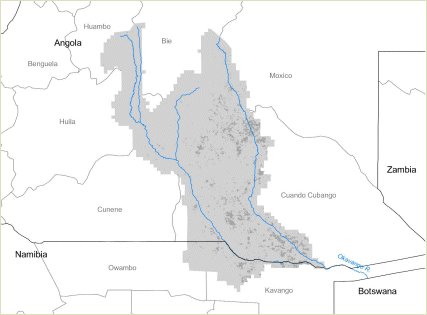
Image from the World Resources Institute's Watersheds of the World, which can be found in HOORC's Library.
World Resources Institute. 2006. EarthTrends: The Environmental Information Portal. Available at http://earthtrends.wri.org. Washington DC: World Resources Institute.
New in HOORC's Library: land cover change thesis
We have just received Jafet Andersson’s Land cover change in the Okavango River Basin : historical changes during the Angolan Civil War: contributing causes and effects on water quality, a Masters thesis for the Department of Water and Environmental Studies at Linköping University. Andersson’s study made use of remote sensing techniques to measure degrees of change in vegetation vigour during the war, and field studies of nutrient concentrations to analyse potential impacts of expanding large-scale agriculture and urban growth on the water quality of the river along the Angola-Namibia border. HOORC researcher Susan Ringrose co-supervised the thesis, which can be found in our Centre’s Library.
Sunday, April 09, 2006
ODMP inception reports
Reports for the Okavango Delta Management Plan project are arriving in HOORC’s library. Final inception reports for Component 5, Wildlife Management – Human Elephant Conflict, from the Dept. of Wildlife and National Parks, and Component 11, Waste Management – Management of liquid and solid waste have been catalogued. A draft inception report for Component 6, Sustainable Tourism and CBNRM, has also been added to the library’s collection.
Friday, April 07, 2006
Livestock wildlife interactions report
The February issue of the online newsletter of the Food and Agriculture Organization of the United Nations’ Livestock, Environment and Development Initiative (FAO – LEAD) announced the publication of Conservation and Development Interventions at the Wildlife/Livestock Interface: Implications for Wildlife, Livestock and Human Health, jointly produced by IUCN and the Wildlife Conservation Society. The report, based on discussions at the Fifth World Parks Congress in Durban, looks at competition over grazing and water resources, disease transmission, local and global food security, and other potential sources of conflict related to land-use decision-making and the reality of resource constraints. The Wildlife Conservation Society, the IUCN Species Survival Commission Veterinary Specialist Group and partners have launched a programme, Animal Health for the Environment And Development (AHEAD) that will continue to look at these issues. The book is available for download from the AHEAD site.

Wednesday, April 05, 2006
Non-timber forest products report
The United Nations Environment Programme World Conservation Monitoring Centre (WCMC) has released the report of a DFID sponsored project that has been looking at commercialization of non-timber forest products. The WCMC web site provides online access to both the report and background files, including the CEPFOR Decision Support Tool, a software tool designed to support the process of decision-making when selecting non-timber forest products for potential development. The tool is designed for use by anyone involved in commercialization of these resources, but is specifically aimed at supporting individuals or organisations working with communities and wanting to improve existing commercialization initiatives or establish new programmes of work. In HOORC’s Library you can find the IUCN supported report, NGO strategy on the environment 2002 - 2007 including strategic plans for forestry & veld products, Okavango Delta, urban environment and wildlife.
Tuesday, April 04, 2006
ODMP fire management work
The inception report for Component Eight of the Okavango Delta Management Plan work, Vegetation Resource Management Fire Management Plan, was presented at HOORC last week by consultants from Environet Solutions. Fire has been used for centuries by people living in the Okavango Delta to control vegetation. Work on this part of Component Eight, to be completed in July 2006, is focused on collection and analysis of information about the long term effects of this burning on the ecology of the Delta Ramsar site. The report can be found in HOORC’s Library.
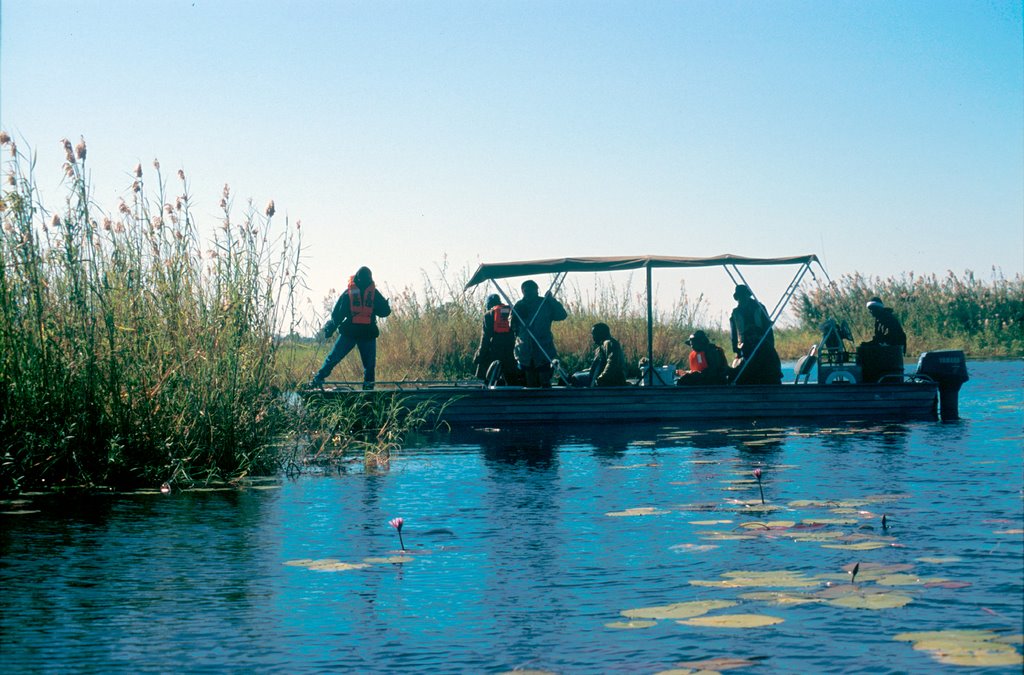
UN wildlife tourism report
UNPulse has alerted us to the publication of a new report, Wildlife watching and tourism: a study on the benefits and risks of a fast growing tourism activity and its impacts on species, produced by the United Nations Environment Programme (UNEP) and the Secretariat of the Convention on the Conservation of Migratory Species of Wild Animals (CMS). The report was launched at the meeting of the UN Convention on Biological Diversity (CBD) in Curitiba, Brazil this past week. Brief case studies – including a look at cheetah and gorilla watching in Africa – support an argument for planning for sustainable tourism. You can access the report at the CMS website.
Monday, April 03, 2006
Okavango floodplain research
HOORC researcher Piotr Wolski and colleague H.H.G. Savenije have published their evaluation of the seasonal and long term dynamics of the surface and groundwater interactions between the floodplains and the islands of the Okavango Delta in a recent issue of the Journal of Hydrology. Surface water-groundwater interactions play a crucial role in the hydrology and ecology of the Delta, which is dominated by the annual arrival of a flood wave. This flood water feeds aquifers underlying the Delta islands. Wolski and Savenije’s work gives us a better picture of the hydrology and eco-hydrology of the Okavango Delta and of floodplain dynamics in other semi-arid regions. Dynamics of floodplain-island groundwater flow in the Okavango Delta, Botswana can be found in HOORC’s Library.
OKACOM news
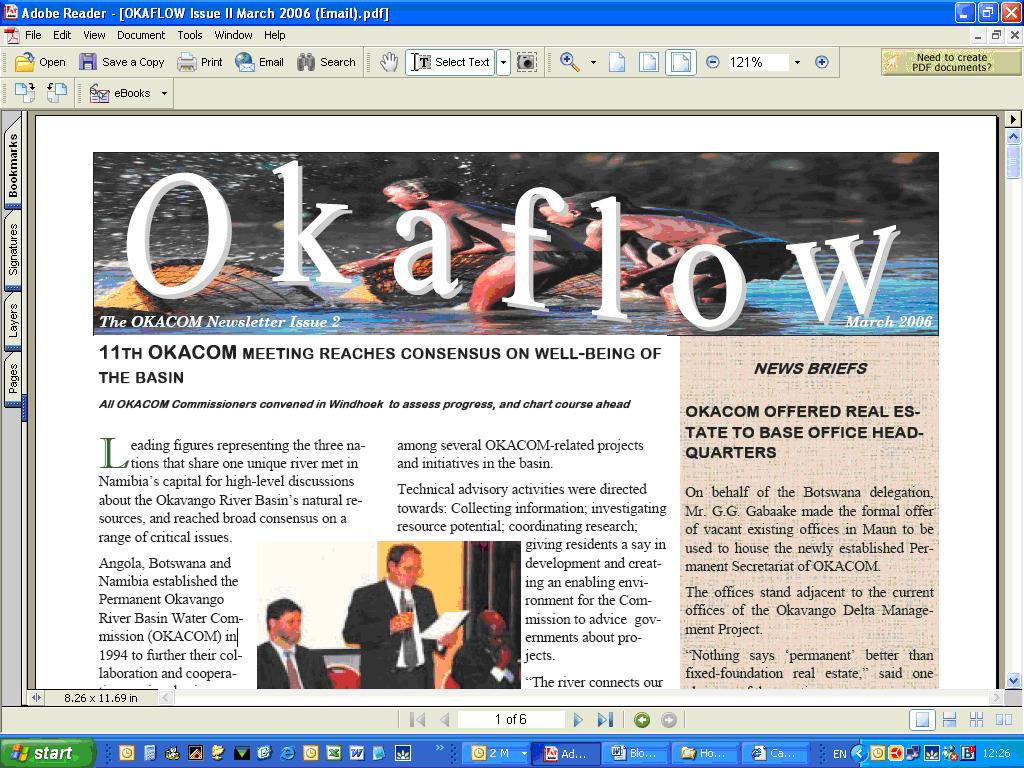
The second issue of the newsletter of the Permanent Okavango River Basin Water Commission (OKACOM), Okaflow, reports that office space for OKACOM’s Secretariat has been identified in Maun. The Commission has been working with partner organizations to identify priority study areas to support its work: these include water resources; water demand; harmonized data; and water quality. You can find issues of Okaflow online.
Subscribe to:
Posts (Atom)